

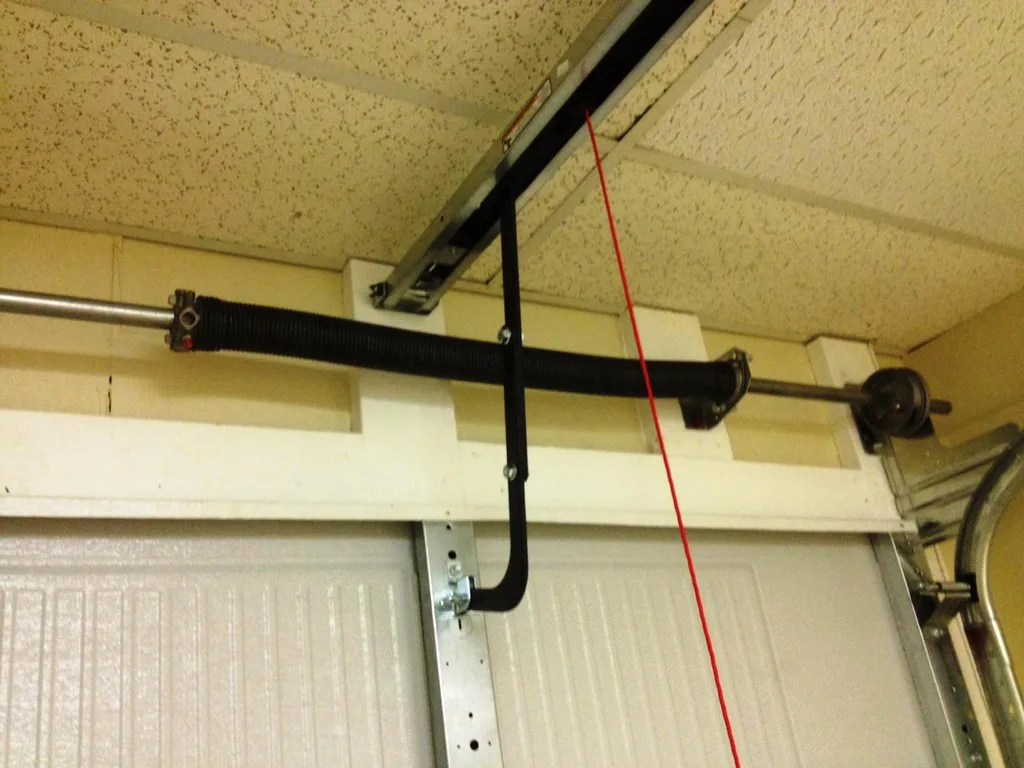
The torsion shaft assembly: what it does and where the danger lives in Nevada garages
You press the button and nothing happens. Not a groan, not a partial lift. Nothing. Or you get a loud bang from somewhere above the door and then nothing. When a torsion spring breaks, the door does not negotiate. It stops. And if you are standing in the garage trying to figure out what happened, the assembly above you is still holding stored energy in whatever structure didn’t fail. This is a piece you can read. The work it describes is not work you do yourself.
What the torsion assembly actually does
The assembly runs horizontally along the header wall above the door opening. A steel shaft (typically one inch in diameter) is supported by bearing plates at each end and a center bearing plate behind the spring. One or two torsion springs mount on that shaft, anchored at the center by a stationary cone and at each end by a winding cone fixed to the shaft with set screws. Two cable drums, one at each end, receive the lift cables that run down to the bottom brackets on the door. For a part-by-part visual of how these components connect to the rest of the system, the garage door parts diagram is the right starting point.
When the door closes, the cables unwind from the drums and pull the springs into a wound state. When the door opens, the springs unwind, rotating the shaft, which rewinds the cables and lifts the door. The springs are not what holds the door up. They counterbalance the weight of the panel so the opener or your arm only has to overcome a few pounds of residual imbalance. Residential steel doors weigh between 130 and 350 pounds, with insulated double-wide panels at the upper end of that range. The torsion assembly is what makes a 300-pound door feel like it weighs eight.
A fully wound spring stores approximately 236 ft-lb of energy at the moment the door closes. That energy is held in place by the shaft, the cones, and the set bolt assembly. For a full technical breakdown of each component, the torsion shaft assembly lab at Garage Door Science covers the engineering in depth.
Spring ratings, wire diameter, and why the numbers interlock
A standard residential torsion spring is rated for approximately 10,000 cycles. At two cycles per day (one open, one close) that’s about 14 years. At four cycles per day, you’re looking at roughly seven. High-cycle oil-tempered springs rated for 25,000 to 100,000 cycles are available as upgrades, and if your door cycles more than four times daily, the cost difference is worth running the math on. In households with home gyms or workshop entrances, four cycles is not an unusual count.
Spring torque output is governed by wire diameter to the fourth power. A spring built from 0.250-inch wire produces roughly 50 percent more torque per turn than the same geometry in 0.225-inch wire. That means a spring is not interchangeable with one that looks similar. Wire diameter, coil diameter, length, and drum size all interlock. Swapping drum sizes without recalculating the spring puts the assembly out of balance, sometimes by a margin large enough that the door will not stay open or will pull itself closed.
How Nevada’s climate concentrates failures at the worst times
Steel contracts at roughly 6.5 millionths of an inch per inch of length per degree Fahrenheit. On a torsion spring, that contraction concentrates stress at spots where the metal is already fatigued. In Northern Nevada, Reno sits at 4,500 feet and Carson City at 4,800, and a spring approaching the end of its rated life in October will very often break on the first hard freeze of December. That is not coincidence. That is metallurgy. The mechanics of cold-weather spring failure explain exactly why the timing clusters around the first freeze of the season rather than distributing evenly across the year.
Las Vegas operates at the other thermal extreme. Sustained temperatures above 110°F from June through September don’t stress torsion springs the way cold does, but the heat degrades every other component simultaneously: opener gears, plastic rollers, weather seal. When those components degrade faster, the door cycles less smoothly, and the cables load the drums unevenly. Uneven drum loading stresses the cable groove flanges laterally. A door that operates two years out of balance can lose a decade of total service life across the entire assembly, motor, cables, rollers, hinges, and brackets included.
What you can check yourself
Pull the opener release cord while the door is closed and lift the door manually to waist height. Let go. A correctly balanced door will stay put or drift no more than an inch or two. A door that crashes downward is undersprung. A door that snaps upward is oversprung. Either condition is a service call. If you want a structured approach with specific tolerances, the balance check guide at Garage Door Science walks through each step in detail.
Visually inspect the spring for a gap between coils. A wound spring has its coils nearly touching. A gap of a quarter inch or more anywhere along the length means the spring has broken or is close to it. Check the cables at the bottom bracket for fraying or rust. Check the drums for cracks at the flange. Lubricate the spring with a purpose-formulated garage door spring lubricant every six months. The spring is under constant tension whether the door is moving or not, which is why it needs more frequent attention than rollers and hinges. Do not use WD-40. Its solvent carrier flushes the existing lubricant out and then evaporates, leaving the metal drier than before.
What you cannot do safely, and why
Any work that requires loosening the set screws on the winding cone is technician work. The cone is what holds the spring’s stored energy against the shaft. Loosening it while the spring is wound releases that energy in the direction of whatever tool is inserted into the cone.
A slipped winding bar can fracture a wrist. It can crack a skull. This is not a description of a rare event. It is a description of what 236 ft-lb of torsional energy does when the restraint releases incorrectly.
Cable replacement carries the same constraint. The cables are under drum tension whenever the door is down. Releasing a cable from the bottom bracket on a closed door releases the spring’s energy through the drum, which spins freely and whips the cable end across the garage. There is no safe version of this task for an untrained person with standard tools.
Where your work ends and a technician’s begins
What you can verify yourself: the balance test, the visual coil inspection, the cable check at the bottom bracket, and the six-month lubrication cycle. What you cannot do safely: anything involving the winding cone, the set screws, or the cables under drum tension. A+ Garage Doors handles spring and cable work throughout the Las Vegas Valley and Northern Nevada, including Reno, Sparks, and Carson City. Las Vegas Valley: (702) 707-2305.
A spring that breaks at 9,500 cycles because nobody looked at it at 7,000 doesn’t just need a new spring. When a torsion spring breaks under load, the cable takes an unplanned shock. A full recovery from a spring failure (spring, cable, and labor) can run $400 to $800. A scheduled inspection before failure is not the same price as an emergency call on a frozen December morning, but it is a much better way to choose the timing.
Protect Your Investment with the Diamond Service Club
Worried about preventing the next garage door issue before it happens? Joining our Diamond Service Club gets you annual preventive maintenance, priority scheduling, and member discounts on repairs. It is investment protection for one of your home’s largest moving systems.
What Our Las Vegas Customers Say
Frequently Asked Questions
How do I know if my torsion spring is broken?
The most reliable field check is the manual balance test: disengage the opener, lift the door to waist height, and let go. If the door drops immediately, the spring is likely broken or significantly undersprung. You can also look for a visible gap of a quarter inch or more anywhere along the coil, which indicates a fracture. In Nevada’s Northern Nevada climate, springs most commonly break on the first hard freeze of the season.
Can I replace a garage door torsion spring myself?
No. A fully wound residential torsion spring stores approximately 236 ft-lb of energy, and loosening the winding cone set screws without correct technique releases that energy through whatever tool is in the cone. A slipped winding bar can fracture a wrist or crack a skull. This is technician work without exception, regardless of how mechanically capable you are.
How long does a residential torsion spring last in Las Vegas?
A standard spring is rated for approximately 10,000 cycles, which converts to roughly seven years of twice-daily use. Las Vegas households that cycle the door four or more times per day will exhaust a stock spring in three to four years. High-cycle oil-tempered springs rated for 25,000 to 100,000 cycles are available and cost-effective above a four-cycle-per-day threshold.
Why do garage door springs break more often in winter in Reno and Carson City?
High-carbon spring steel contracts at roughly 6.5 millionths of an inch per inch of length per degree Fahrenheit. On a spring already fatigued near the end of its rated cycle life, that thermal contraction concentrates stress at the weakest point in the coil and can initiate or propagate a fracture. Reno sits at 4,500 ft and Carson City at 4,800 ft, so first-freeze temperatures in December routinely push springs past their fatigue threshold.
What lubricant should I use on my garage door torsion spring?
Use a purpose-formulated garage door spring lubricant applied in a light coat every six months. Do not use WD-40. Its solvent carrier flushes existing lubricant out of the metal contact surfaces and then evaporates, leaving the spring drier than it was before treatment. In Las Vegas, the combination of summer heat and fine Mojave dust makes the six-month interval non-negotiable rather than a general suggestion.
My garage door slams down when I let go during the balance test. Is that dangerous?
Yes. A door that drops immediately when released at waist height is undersprung, meaning the torsion assembly is no longer providing enough counterbalance for the door’s weight. That condition strains the opener motor, accelerates cable wear, and creates an entrapment hazard if the opener’s auto-reverse force limit has not been recalibrated to match. Schedule a service call before using the door further.


